
Your home should be a place where your family feels comfortable, safe, and healthy. However, the air inside your home may contain pollutants that affect your family’s well-being without obvious warning signs. Professional air quality testing can help you better understand potential concerns, identify hidden moisture problems, and determine what steps may help improve the air your family breathes.
What Is Indoor Air Quality?
Indoor air quality (IAQ) refers to the condition of the air inside a building and how it affects the health and comfort of its occupants. Several factors contribute to your home’s indoor environment:
- Ventilation
- Humidity
- Temperature
- Climate
- Building materials
- Airborne pollutants
Good indoor air quality depends on controlling pollution sources, managing moisture, and maintaining adequate ventilation, but a professional indoor air assessment can help identify concerns that may not be obvious. Depending on your home’s conditions, air quality testing may help investigate suspected contamination and guide appropriate next steps.
Should You Consider an Air Safety Test?
Indoor air problems are not always visible. Some develop gradually, while others become noticeable after water damage, renovations, or changes in household ventilation.
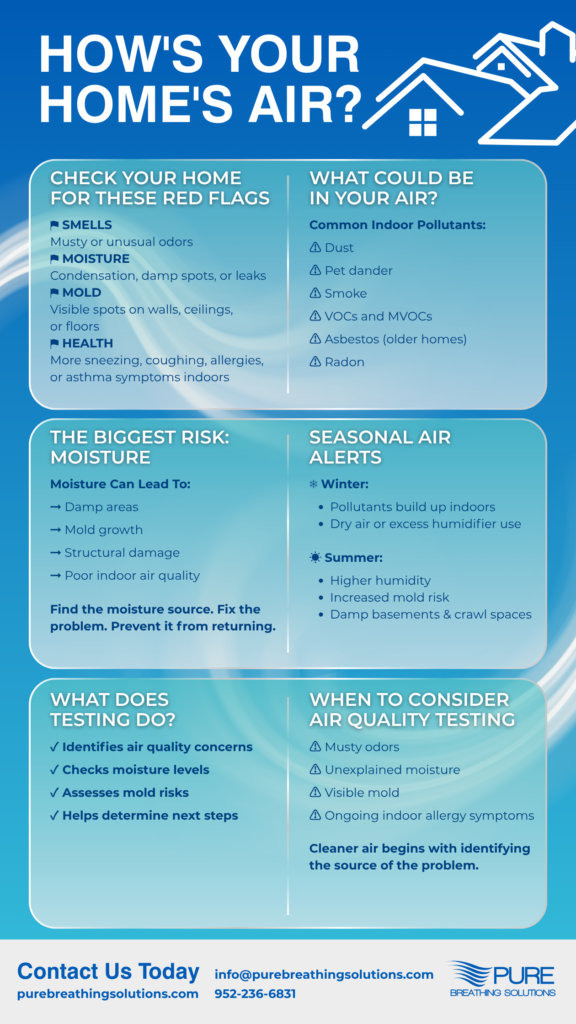
Common warning signs that may point to the need for air quality testing include:
- Persistent musty or unusual odors
- Visible mold or discoloration on walls, window sills, ceilings, or floorboards
- Condensation on windows or consistently damp areas
- Water stains, past leaks, or materials that never fully dried
- Increased coughing, sneezing, or respiratory irritation indoors
- Allergy or asthma symptoms
These symptoms can have multiple causes, so they don’t automatically indicate an indoor air problem, but when symptoms persist or are noticeably worse at home, it’s worth an indoor air assessment.
Moisture is a particularly important concern. Unaddressed, it creates conditions ripe for mold, which damages building materials and contributes to respiratory irritation or worsening allergy and asthma symptoms in some people. If you suspect mold, consider getting a mold assessment alongside your air quality testing.
Indoor Air Pollutants
Your home may contain several types of indoor pollutants. Common examples include:
- Dust
- Pet dander
- Secondhand smoke
- Volatile organic compounds or VOCs (released by certain household products)
- Outdated building materials like asbestos
- Radon
When a pollutant or moisture issue is suspected, air quality testing and other targeted indoor air assessments can help narrow down possible causes.
Seasonal Indoor Air Concerns
During winter, reduced outdoor air exchange allows indoor pollutants to accumulate. Heating systems dry the air, while excessive humidifier use contributes to moisture on cold windows and walls. During summer, humid outdoor air, heavy rainfall, and water intrusion increase moisture levels in basements and crawl spaces. Poor drainage and inadequate moisture control often create favorable conditions for mold growth.
When the weather starts to change, that’s an important time to watch for the warning signs of moisture buildup and flaring health symptoms. An indoor air assessment will help determine how to move forward if seasonal problems persist.
What Happens During a Professional Air Quality Assessment?
“Air quality testing” is an umbrella term for several different assessment methods, each targeted toward a specific contaminant. Humidity, for example, is measured with a hygrometer or moisture meter, while radon can be assessed with a test kit or monitored with a detector.
During an air safety test, a qualified professional may review the home’s history, assess visible conditions, evaluate moisture sources, and collect air or surface samples when appropriate. The methods depend on your concerns and your house’s specific conditions.
How Air Quality and Mold Remediation Are Related
When mold is uncovered through mold testing, addressing visible growth alone is not enough. The underlying moisture problem must also be identified and corrected to help prevent mold from returning and further affecting your indoor air quality.
Professional mold remediation focuses on removing affected materials, cleaning contaminated areas, and addressing the conditions that allowed mold to grow. After remediation, mold testing may be appropriate to test the effectiveness of the remediation.
The Next Step Toward Healthier Indoor Air
Healthy indoor air begins with understanding what is happening inside your home. If you have noticed persistent musty odors, unexplained moisture, or signs of mold, professional mold testing can help you identify the cause and determine an appropriate response.
Pure Breathing Solutions helps Minnesota homeowners address mold, moisture, and other air quality concerns through testing, remediation, basement waterproofing, and crawl space encapsulation. Contact our team to discuss your concerns and learn how a personalized air quality assessment can help.